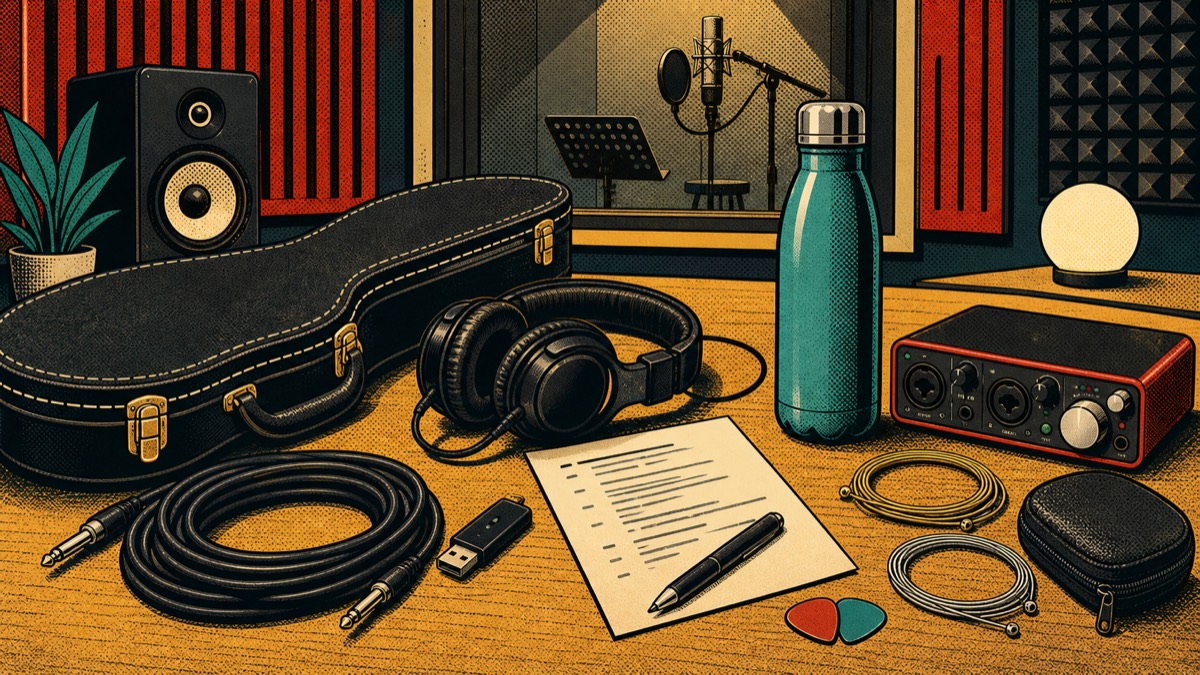
Quick answer: bring your song structure, reference tracks, tuned instruments, spare strings or accessories, labelled WAV files or stems, and a clear goal for what you want to finish in the session.
A Glasgow recording studio gives you access to microphones, rooms, monitoring, and engineering support that are hard to recreate at home. But the best sessions still depend on preparation. If you arrive with the right files, instruments, references, and expectations, the session can move quickly and creatively.
You do not need to over-prepare to the point that the music feels stiff. The aim is to remove avoidable friction, so the time in the room can go into performance and sound.
Bring the final song structure
Before recording, make sure everyone agrees on the arrangement. Know how many verses, choruses, bridges, breaks, endings, and tempo changes there are. If the song is still changing every few minutes, studio time can disappear into decisions that are better made in rehearsal.
A simple lyric sheet or chord chart can be enough. If there are unusual stops, cues, or arrangement changes, write them down clearly.
Bring reference tracks
Reference tracks are songs that help explain the sound you are aiming for. They might show the vocal tone, drum sound, guitar texture, mix style, or overall energy you like. References do not mean copying another artist; they give everyone a shared language.
Try to bring two or three references rather than twenty. A focused shortlist is more useful than a long playlist with conflicting ideas.
Prepare your instruments
If you are bringing guitars, basses, pedals, keyboards, or other instruments, check them before the session. Fresh strings, reliable cables, spare batteries, and tuned drums can save a surprising amount of time.
- Change guitar strings early enough that they can settle.
- Bring spare strings, picks, sticks, straps, and batteries.
- Check intonation and tuning stability.
- Make sure pedals and power supplies are working.
Bring your files in a usable format
If you are bringing backing tracks, demos, stems, or existing project files, export them clearly. WAV files are usually the safest option. Label everything in a way that makes sense, such as drums, bass, piano, lead vocal, backing vocal, and guide guitar.
If the session needs to line up with existing audio, export all files from the same start point. That helps the engineer import everything quickly without guessing where each part begins.
If in doubt, bring both the individual stems and a rough stereo bounce of the track. The bounce acts as a reference for how everything should fit together.
Know what you want to complete
A session can cover recording, editing, production, mixing, or a combination of those things. Before you arrive, decide what a successful session looks like. Are you trying to capture final vocals? Build a demo? Record drums? Finish a podcast intro? The clearer the goal, the easier it is to prioritise.
If you have a deadline, mention it early. That helps shape decisions around what should be recorded now, what can be edited later, and what needs extra care in the room.
Bring the right people
It can be helpful to have a producer, bandmate, or trusted listener in the room, but too many opinions can slow a session down. Bring the people who genuinely need to be part of the decision-making process.
For vocals, it is often best to keep the room calm and focused. A relaxed performer will almost always give a better take than someone trying to impress a crowd.
Final checklist
- Lyrics, chord charts, or arrangement notes
- Reference tracks
- Instruments, accessories, and spares
- Backing tracks, stems, demos, or project files
- Water and anything you need to stay comfortable
- A clear goal for the session
Recording in Glasgow with Triple M Studios
Triple M Studios supports artists, bands, vocalists, and creators recording in the Glasgow area. Whether you are working on a demo, single, EP, voiceover, or podcast intro, a prepared session gives you more time to focus on performance and less time solving avoidable problems.